Key research insights
- Self-efficacy protects maternal mental health: Evidence from the studies shows that a strong sense of self-efficacy (SE) is consistently linked to better mental wellbeing. It acts as a buffer, with higher SE correlating to lower rates of postpartum depression and anxiety (Han et al., 2022; Wensu et al., 2021). Furthermore, strong general self-efficacy is associated with a significantly reduced fear of childbirth (Zhang et al., 2023).
- Fathers play a crucial protective role: A father’s self-efficacy is vital for the health of the family unit. High self-efficacy in fathers acts as a protective shield for family cohesion (family alliance), even in challenging situations where the mother’s self-efficacy is low and parental stress is high (Favez et al., 2024).
- Self-efficacy drives healthy behaviours: A mother’s belief in her own capability strongly predicts positive health actions. For example, self-efficacy is the most important predictor of a pregnant woman’s ability to successfully quit smoking (Acar & Berk, 2022). Similarly, an increase in a mother’s perceived self-efficacy helps in actively managing a child’s diet and weight over time (Derwig et al., 2022).
- Resilience remains a powerful core factor: While self-efficacy is important, broader psychological resilience is often the strongest overall protector against psychological distress (such as anxiety and depression) during pregnancy (Mei et al., 2022).
Why some people experience low self-efficacy
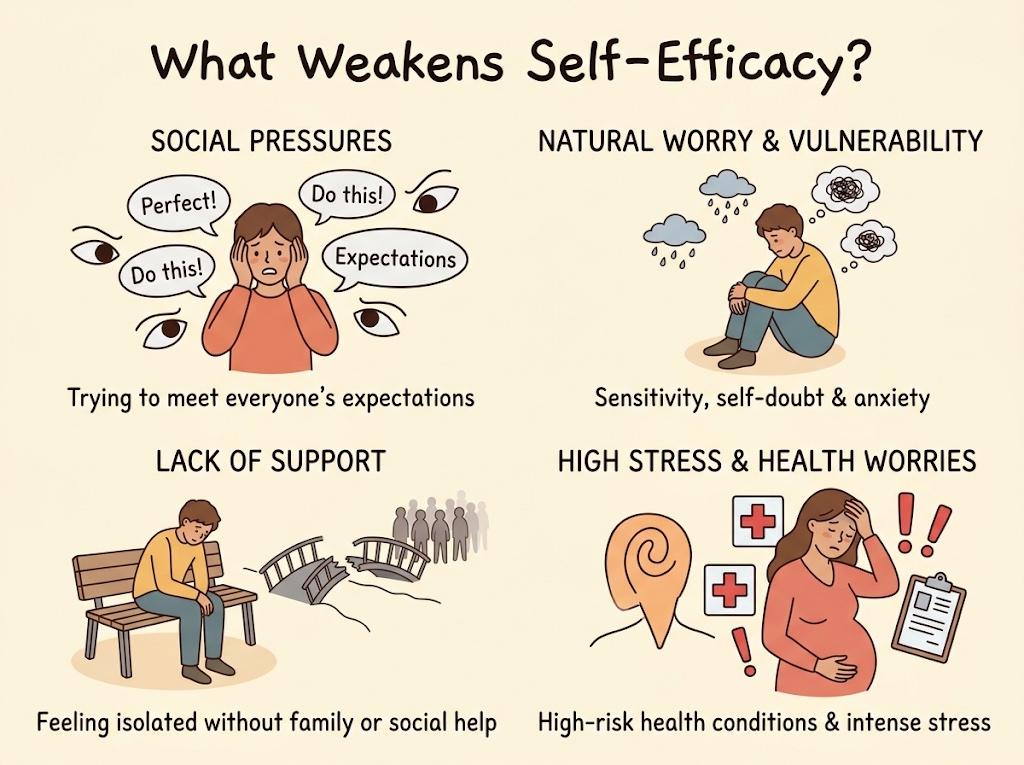
- The burden of social expectations: Mothers who exhibit high “defensiveness”, defined as a tendency to try to meet society’s expectations of a perfect mother rather than expressing their authentic, genuine feelings, experience higher levels of anxiety and depression. This emotional toll directly damages their parental self-efficacy (Kestler-Peleg, 2023).
- Vulnerable personality traits: Individuals with “vulnerable” personality traits (characterised by high sensitivity, excessive worry, and timidity) naturally struggle more with self-belief. This resulting lower self-efficacy makes them significantly more susceptible to developing postpartum depression (Han et al., 2022).
- Poor family and social support networks: A lack of emotional support directly impacts a mother’s confidence. Poor family functioning increases anxiety and depression, which in turn severely drain a mother’s self-efficacy (Wensu et al., 2021). Conversely, good family functioning, strong social support, and clear communication with doctors help prevent the fear of childbirth entirely (Zhang et al., 2023).
- High-risk medical conditions increase stress: Experiencing a high-risk pregnancy creates intense physiological and mental stress. If unaddressed, this stress can erode a mother’s sense of empowerment and her positive outlook on the future (Aliabadi et al., 2022).
Practical strategies
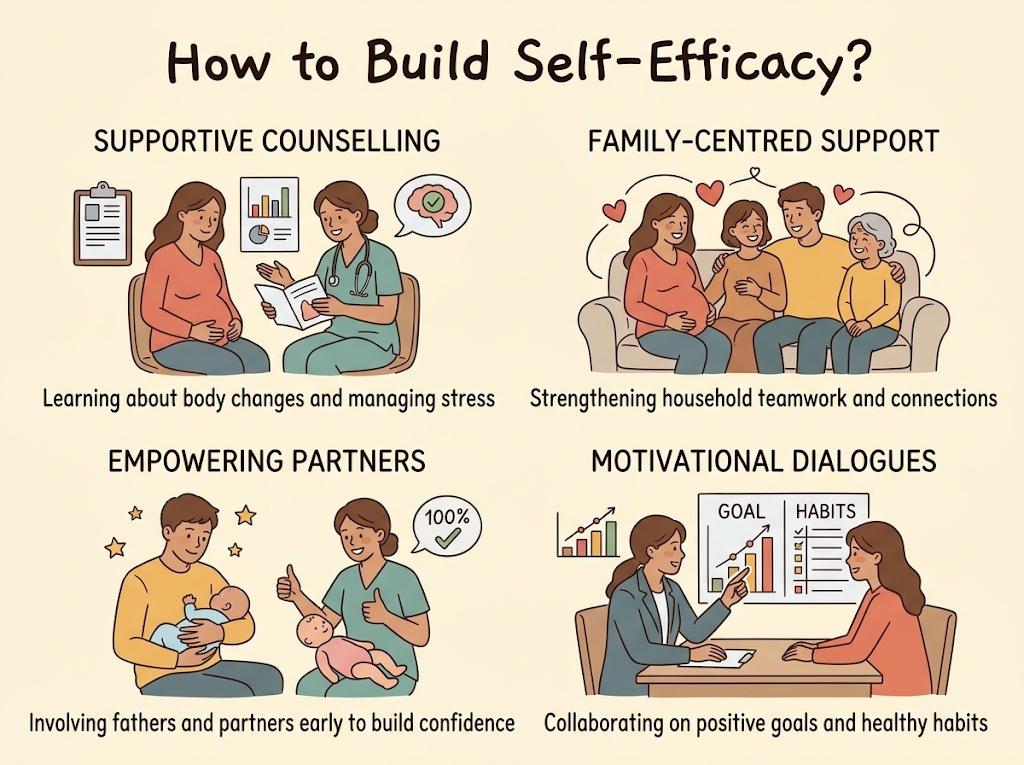
- Structured midwifery counselling: Midwifery programmes that focus on explaining bodily changes, accepting current health conditions, and offering concrete stress-reduction solutions can significantly boost empowerment and reduce stress, particularly in high-risk pregnancies (Aliabadi et al., 2022).
- Focusing on family-centred support: Healthcare interventions should not only target the mother but also aim to improve overall family functioning. Strengthening the household dynamic directly improves maternal self-efficacy and lowers depression (Wensu et al., 2021; Zhang et al., 2023).
- Empowering fathers early: Parenting programmes must actively build the father’s confidence and skills. Because a father’s self-efficacy protects the family alliance during highly stressful periods, engaging fathers during the antenatal stage is a key preventative strategy (Favez et al., 2024).
- Motivational interviewing for behaviour change: For specific challenges like smoking, simple advice is rarely enough. Motivational interviewing and stage-based counselling have been shown to effectively increase self-efficacy and help pregnant women successfully alter their habits (Acar & Berk, 2022).
- Child-centred health dialogues: When discussing sensitive topics like childhood obesity, healthcare professionals should use empowering, interactive tools focused on promoting healthy lifestyle habits rather than just focusing on the child’s weight. This approach successfully improves maternal self-efficacy in managing family diets (Derwig et al., 2022).
Exercises and reflection prompts
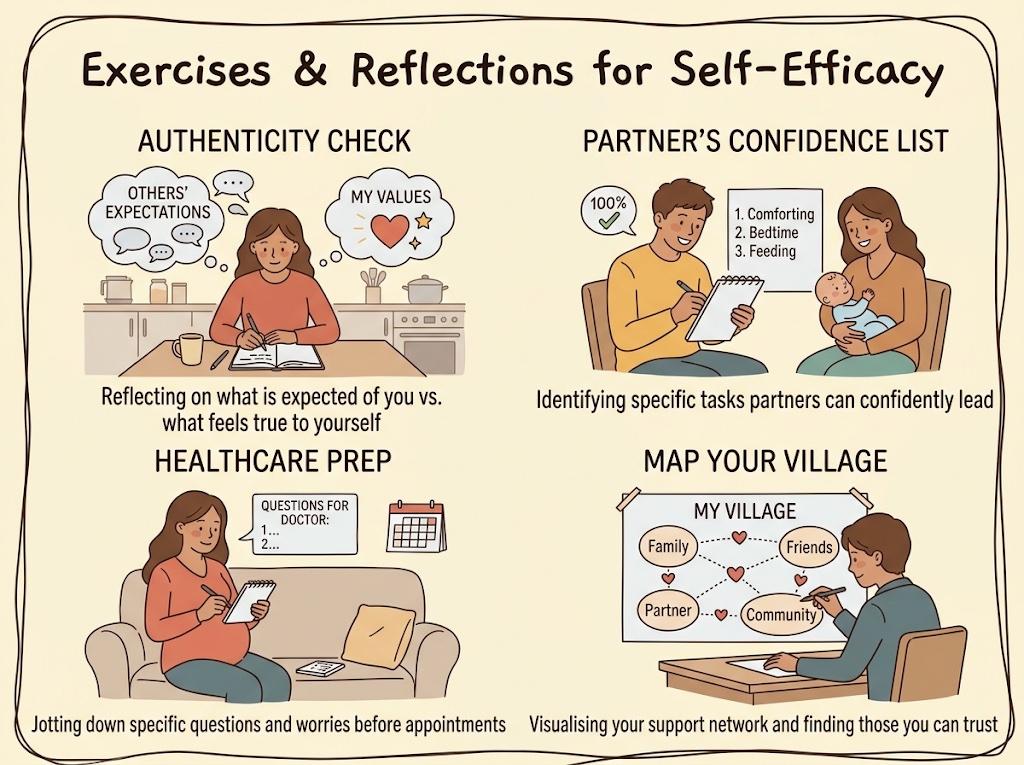
- The “authenticity vs. expectation” check: Reflect on the past week. Write down one parenting action you took primarily because you felt society or others expected it of you, and one action you took because it felt authentic to your own values. How did each choice affect your stress levels? (Inspired by Kestler-Peleg, 2023.)
- Fathers’ confidence builder: For partners: list three specific parenting tasks or support roles you feel highly confident in. Discuss with your partner how you can automatically take the lead on these tasks during high-stress moments to protect the family’s wellbeing. (Inspired by Favez et al., 2024.)
- Healthcare communication plan: Before your next medical appointment, write down two specific worries or questions regarding your pregnancy or childbirth. Having a clear plan improves doctor-patient communication, which is proven to actively reduce the fear of childbirth. (Inspired by Zhang et al., 2023.)
- Identifying the “support village”: Map out your current social and family support network on a piece of paper. Identify one person you can speak to openly without fear of judgment. Strengthening this specific, functional support link is a proven way to boost personal self-efficacy and lower anxiety. (Inspired by Wensu et al., 2021.)
Sources
- Acar, D., & Berk, Ö. S. (2022). Smoking cessation in pregnancy within the framework of health behavioral theories: A current review. Psikiyatride Guncel Yaklasimlar, 14(2), 152–164. doi.org/10.18863/pgy.898127
- Aliabadi, S., Shayan, A., Refaei, M., Tapak, L., & Moradveisi, L. (2022). The effect of individual counseling based on the GATHER principles on perceived stress and empowerment of the mothers with high-risk pregnancies: An experimental study. BMC Psychiatry, 22(1), 396. doi.org/10.1186/s12888-022-04047-2
- Bayındır, A., & Tosun, H. (2025). A study on emotional intelligence, breastfeeding self-efficacy, and prenatal maternal expectations in women attending a pregnancy school. Journal of Intelligence, 13(3), 35. doi.org/10.3390/jintelligence13030035
- Crespo, M., Kestler-Peleg, M., Catalá, P., Arribas, C., & Peñacoba, C. (2025). Evolution of life satisfaction throughout the gestation process and at different postpartum stages. Behavioral Sciences, 15(10), 1390. doi.org/10.3390/bs15101390
- Derwig, M., Tiberg, I., Björk, J., & Kristensson Hallström, I. (2022). Changes in perceived parental self-efficacy after a Child-Centred Health Dialogue about preventing obesity. Acta Paediatrica, 111(10), 1956–1965. doi.org/10.1111/apa.16453
- Favez, N., Rattaz, V., Puglisi, N., Razurel, C., Epiney, M., & Tissot, H. (2024). The interplay between maternal and paternal senses of efficacy moderates the link between perinatal parental stress and family alliance at 3 months. Parenting, 24(1), 30–38. doi.org/10.1080/15295192.2023.2254818
- Flykt, M., Kilpeläinen, M., Kinnunen, S., Salonen, M., Peltonen, K., Isosävi, S., & Lindblom, J. (2025). Effectiveness and treatment moderators of parenting interventions in Finnish perinatal primary care. Infant Mental Health Journal, 46(5), 577–603. doi.org/10.1002/imhj.70007
- Han, L., Zhang, J., Yang, J., Yang, X., & Bai, H. (2022). Between personality traits and postpartum depression: The mediated role of maternal self-efficacy. Neuropsychiatric Disease and Treatment, 597–609. doi.org/10.2147/ndt.s346327
- Kestler-Peleg, M. (2023). The cost of pleasing social expectations: A serial mediation of Israeli mothers’ anxiety and depression in the relationship between defensiveness and parental self-efficacy. Feminism & Psychology, 33(4), 692–701. doi.org/10.1177/09593535221130698
- Liu, J., Liu, X., & Ding, M. (2024). The impact of a positive discipline group intervention on parenting self-efficacy among mothers of young children. Frontiers in Public Health, 12, 1461435. doi.org/10.3389/fpubh.2024.1461435
- Mei, X., Mei, R., Liu, Y., Wang, X., Chen, Q., Lei, Y., & Ye, Z. (2022). Associations among fear of childbirth, resilience and psychological distress in pregnant women: A response surface analysis and moderated mediation model. Frontiers in Psychiatry, 13, 1091042. doi.org/10.3389/fpsyt.2022.1091042
- Özer, D., & Dişsiz, M. (2025). Effects of mindfulness-based practices in the perinatal and postpartum periods on women’s health: A systematic review. Psikiyatride Güncel Yaklaşımlar, 17(1), 147–165. doi.org/10.18863/pgy.1464521
- Samdan, G., Reinelt, T., Kiel, N., Mathes, B., & Pauen, S. (2022). Maternal self-efficacy development from pregnancy to 3 months after birth. Infant Mental Health Journal, 43(6), 864–877. doi.org/10.1002/imhj.22018
- Wensu, Z., Xidi, Z., Shaojie, L., Baohua, Z., Yunhan, Y., Huilan, X., … & Xiyue, X. (2021). Does the presence of anxiety and depression symptoms mediate the association between family functions and self-efficacy in pregnant women in the third trimester? A community-based cross-sectional survey. Frontiers in Psychiatry, 12, 726093. doi.org/10.3389/fpsyt.2021.726093
- Zhang, T., Liu, M., Min, F., Wei, W., Liu, Y., Tong, J., … & Chen, X. (2023). Fear of childbirth and its determinants in pregnant women in the third trimester: A cross-sectional study. BMC Psychiatry, 23(1), 574. doi.org/10.1186/s12888-023-05070-7
- Zhou, N., Wu, D., Liu, M., Hu, S., Zhang, F., Zan, Y., & Sun, F. (2025). The mediating role of self-efficacy in the relationship between eHealth literacy and childbirth readiness among pregnant women: A cross-sectional study. Frontiers in Public Health, 13, 1561855. doi.org/10.3389/fpubh.2025.1561855